

Contest Basics
FastDraft’s Rabbit format offers an exciting on-ramp to the Best Ball universe, featuring quarterbacks, running backs, wide receivers, and tight ends. This strategy guide will cover the foundational rules before unpacking advanced tactics that can help you chase down a first-place finish. The debut 2025 contest sports a rake-free $50,000 prize pool — with a cool $10,000 up top — and a $20 entry fee. It’s capped at 2,500 total entries (75 max per user), and each 10-team draft selects 15 players, meaning exactly 150 players are off the board in every room. As this contest gets close to filling it will be vital to be using your Spike Week tools to maximize your edge.
Use promo code: SPIKE in the FastDraft app to receive a 100% deposit bonus up to $50 on your initial deposit.
As this is Best Ball, the highest-scoring players are automatically selected for your starting lineup each week. It is a 15 round draft with a 3rd round reversal. The Rabbit format is season long cumulative scoring weeks 1-17. FastDraft uses full PPR scoring. Each week’s starting lineup consists 1 – QB, 2 – RB, 2 – WR, 1 – TE, 2 – FLEX. This means 7 players are on your bench each week.
Pick clocks are 20 seconds, you are looking at a maximum of 50 minutes per draft in the format if everyone runs out the clock on the pick. Very unlikely as users are coming here for a fast draft! I imagine most drafts will take only around 20-25 minutes.
Strategy
Structure
This contest is the slimmest full roster Best Ball contest I’ve seen. 15 roster spots and 8 starters each week, more importantly 6 of 8 can be RB/WR’s. What initial structure thoughts come to mind:
- Elite players matter more. Elite or Punt at both QB and TE. Each position will have around 20 drafted. You should really set a 2 max limit on each, ideally different byes at QB. Do you really need to pay up for Baker Mayfield when Dak Prescott and Trevor Lawrence are readily available later?
- It’s a Zero RB paradise. It is much easier historically to find RB’s that mass produce later in drafts. Not so much at WR. I for sure as a general rule want 4 WR through 6 rounds. I’m very open to starting 1 – Elite QB, 4 – WR and 1 – Elite TE. With this build, my final structure might be 2-6-5-2 or 2-6-6-1.
- Yes, you can still draft the Elite RB’s. Focus on who has the upside to be the top overall player on a Full PPR site. Jonathan Taylor, not so much. If I took an elite RB, I’m probably building out using Hero principles, but two is also probably fine.
Ownership
Ownership is going to be an important factor on how to build your teams. Through 12 of the 250 drafts; 128 of the players have a 100% Ownership rate. A player like Ja’Marr Chase will be drafted in every draft, leading to 250 Chase teams. Tyler Allgeier is currently only drafted 53.8% of the time, or 135 teams. Let’s move down a bit and think about Will Shipley. He is currently only drafted 7.7% of the time and would only be on 19 teams. The debut 2025 contest is currently 4.4% full, so the team numbers here could change dramatically once Spike Weekers begin jumping into these contests. It’s crucial to monitor backup running backs who could move into starting roles because of injuries, if it occurs, they probably will not rise high enough.
Combinatorial Ownership
Combinatorial Ownership is going to give you massive leverage in this contest. It’s not just about how often a single player is drafted — it’s about how often specific combinations of players appear together on rosters. For instance, Saquon Barkley has been paired with Jakobi Meyers in 75% of drafts! That is laugh out loud funny in many ways. I cannot recommend using TournamentDB enough while drafting. Access to TournamentDB is available via Spike Week Premium. Since only 150 players are drafted in each room and there are so many possible team constructions, even common players can become part of incredibly unique builds when paired with less-drafted options. By being intentional about how your players overlap with others in the field, you can build teams that are both high-upside and hard to duplicate, increasing your chances of standing alone at the top when it matters most. Using the Draft Board and Common Combos will provide insights about what your competition is doing. Are you going to be the first person to draft Nico Collins and Brian Thomas Jr. together? I’ll also be very keen on identifying which QB’s are and aren’t paired together often.
Stacking
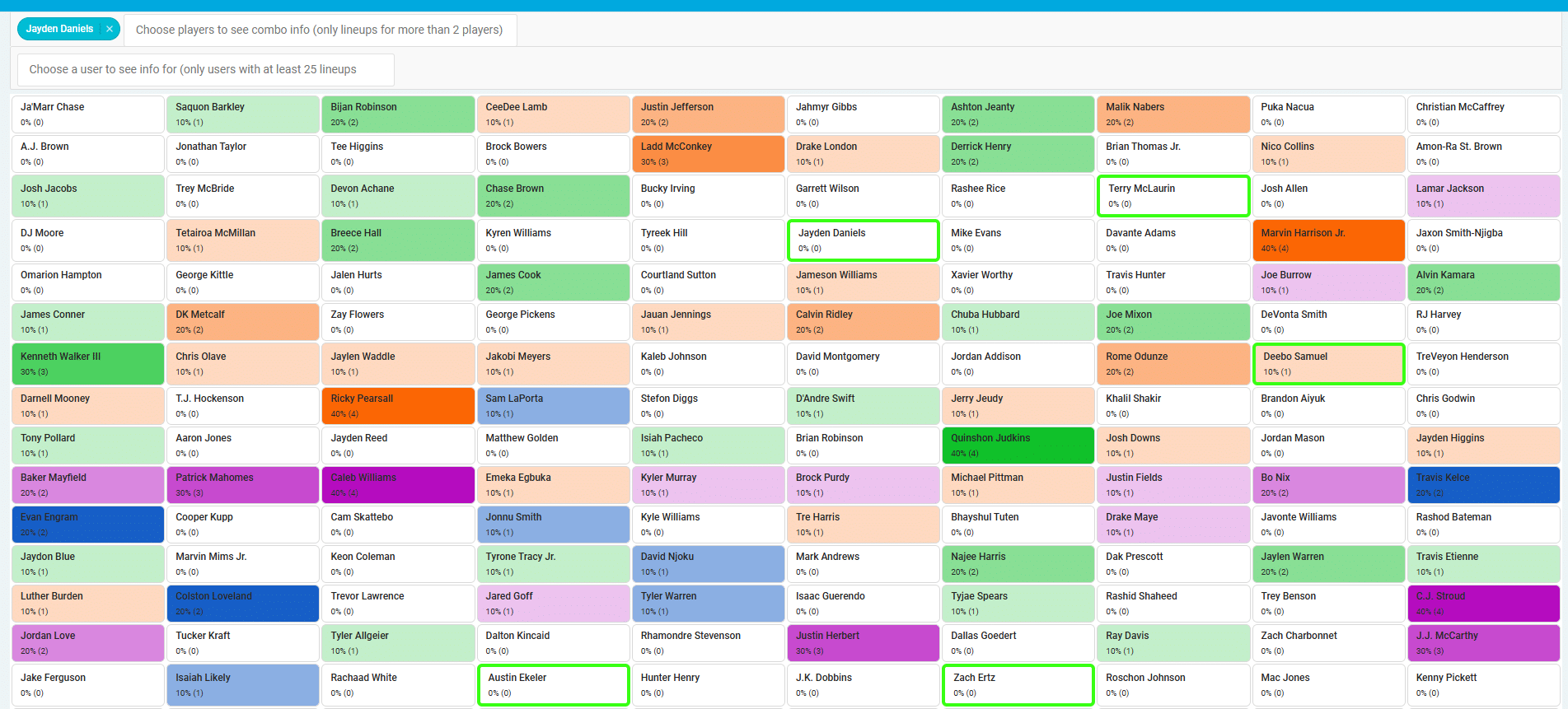
Stacking unlocks multiple strategic advantages in Best Ball. At its core, it’s about leveraging correlated scoring outcomes: when your quarterback has a big week, chances are his pass-catchers do too. By pairing them, you magnify your ceiling during those spike weeks. It also reduces the number of variables you’re relying on to win. Instead of needing multiple unconnected things to break your way, you’re betting on one high-scoring offense to carry your squad. Through the initial eight drafts, we can see the field is stacking but probably not enough. For example; Dak is paired with CeeDee Lamb 3 times, Zay Flowers with Lamar Jackson twice and Jayden Daniels never with Terry McLaurin.
Conclusion
I’m fired up to dive into the Rabbit tournament and explore everything FastDraft has to offer. There’s a brand-new strategic challenge on the table, and I can’t wait to crack it. Keep an eye out for fresh content and new tools geared specifically toward FastDraft this summer. If this piece sparked any strategic thinking, hop into the FastDraft-NFL channel in the Spike Week Discord and let’s talk shop. This format is a playground for creativity, and sometimes it’s the bold, unconventional builds that separate a strong finish from a tournament takedown. Embrace the weird — it might just be your secret weapon. Best of luck, and I’ll see you climbing the leaderboard!